Gonzalo Eguiguren
A selection of works tracing Gonzalo Eguiguren’s career through discoveries, research and acquisitions. It brings together works in the gallery’s current collection and others now in museums or private collections, alongside projects undertaken with cultural institutions.
About the Gallery →
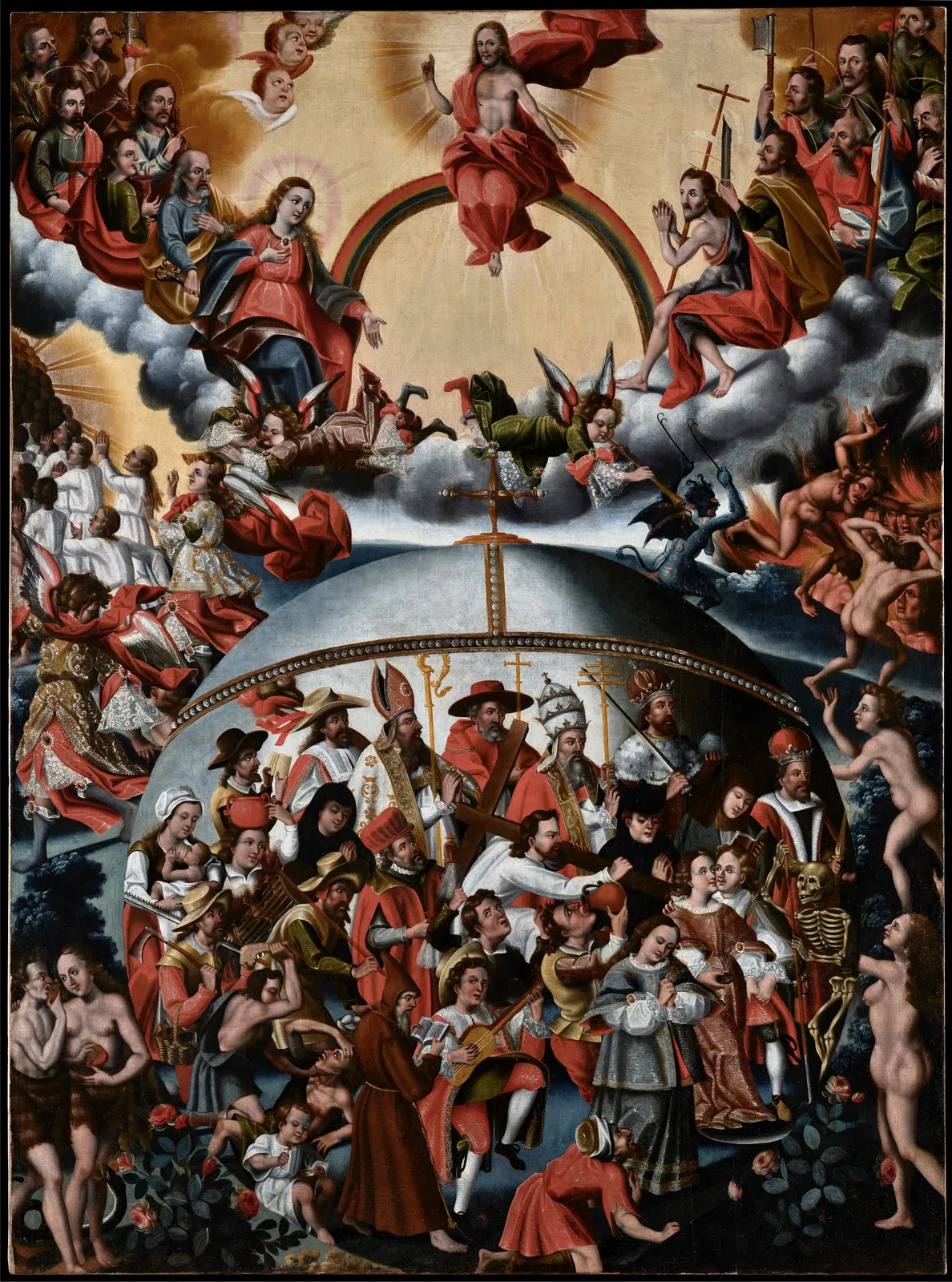
The Last Judgement by Leonardo Flores
Discovered and researched by Gonzalo Eguiguren, this painting holds a central place in his work on Andean painting. Its presentation traces the identification and study of a work that remains in the gallery’s current collection.
Explore the work →

The Kotte Fan
Known as the Pangolin Fan, this ivory, silver and carnelian fan was made in Kotte, in present-day Sri Lanka, between 1540 and 1551. Discovered by Gonzalo Eguiguren, it brings together his interests in ivory carving and artistic encounters between Asia and Europe.
Explore the work →

The Pietà attributed to Melchor Pérez Holguín
Located and studied by Gonzalo Eguiguren during his time at Jaime Eguiguren Art & Antiques, the painting was acquired by LACMA in 2019. The museum dates it to around 1720 and catalogues it as attributed to Melchor Pérez Holguín.
Explore the work →

Portraits in Feather Mosaic
Gonzalo Eguiguren’s work includes the study of the portrait of Fabio Chigi, Pope Alexander VII, in Discovering Viceregal Latin American Treasures and the sale of the portrait of Cardinal Giulio Rospigliosi to MUDEC in Milan, which acquired it in 2025. In his 2024 report, Davide Domenici identified these as the two known New Spanish portraits of this type.
Explore the work →

Saint Barbara by Bartolomé de Arenas
The signed Saint Barbara by Bartolomé de Arenas is the starting point for Gonzalo Eguiguren’s research on the painter. His study proposes attributing to Arenas two portraits of Fray Payo Enríquez de Ribera, depicting him as Archbishop and as Viceroy of New Spain.
Explore the work →

Luisa Roldán and the Museo Nacional de Escultura
The loan of Saint Joseph and the Christ Child to the exhibition devoted to Luisa Roldán at the Museo Nacional de Escultura in Valladolid in 2024–2025 forms part of the gallery’s work to study European sculpture and share it with a wider public.
Explore the work →

The Macanese Folding Screen
The discovery of this late Ming dynasty folding screen led to a research project directed by Gonzalo Eguiguren. Its landscape and symbolic imagery offer a way to explore the relationship between Chinese painting traditions and the production of folding screens associated with Macao.
Explore the work →

Collections of Enconchado Paintings
Direct work with several collections of enconchado paintings has been a continuing part of Gonzalo Eguiguren’s career. Combining painting with mother-of-pearl, these works hold a particular place in his interest in the techniques and artistic exchanges of New Spain.
Explore the work →

The Cabinet acquired by LACMA
This eighteenth-century Guatemalan contador, inlaid with tortoiseshell and mother-of-pearl, was sold to LACMA with Gonzalo Eguiguren’s involvement. The museum acquired it in 2024. Its design and materials show how American workshops reinterpreted models from Europe and Asia.
Explore the work →

The Pátzcuaro and Taller de los Galgos Bateas
The Pátzcuaro batea and the example associated with the so-called Taller de los Galgos form part of Gonzalo Eguiguren’s direct experience of the decorative arts of Mexico. Both offer an opportunity to examine the relationship between materials, ornament and local traditions.
Explore the work →

The Guatemalan Altarpiece of the Virgin of Guadalupe
Made by a Guatemalan artist around 1750–1780, this small altarpiece forms part of the gallery’s collection. Its inclusion reflects an interest in devotional objects and the adaptation of Marian imagery in different artistic centres across the Americas.
Explore the work →
