Based in Madrid, Gonzalo Eguiguren Gallery specialises in paintings, sculpture and works of art, with a particular interest in European Old Masters, the art of viceregal Latin America and works shaped by exchanges between Europe, the Americas and Asia.
Artistic quality and the distinctive character of each work guide the selection. The decorative arts are an essential part of this approach: a piece of silver, an item of furniture or a textile can bring together remarkable craftsmanship and a history worth telling.
Research accompanies the presentation of the works and is shared through publications, exhibitions and conversations with collectors. The gallery offers a place to discover works of art, understand their context and appreciate the choices made by their makers.
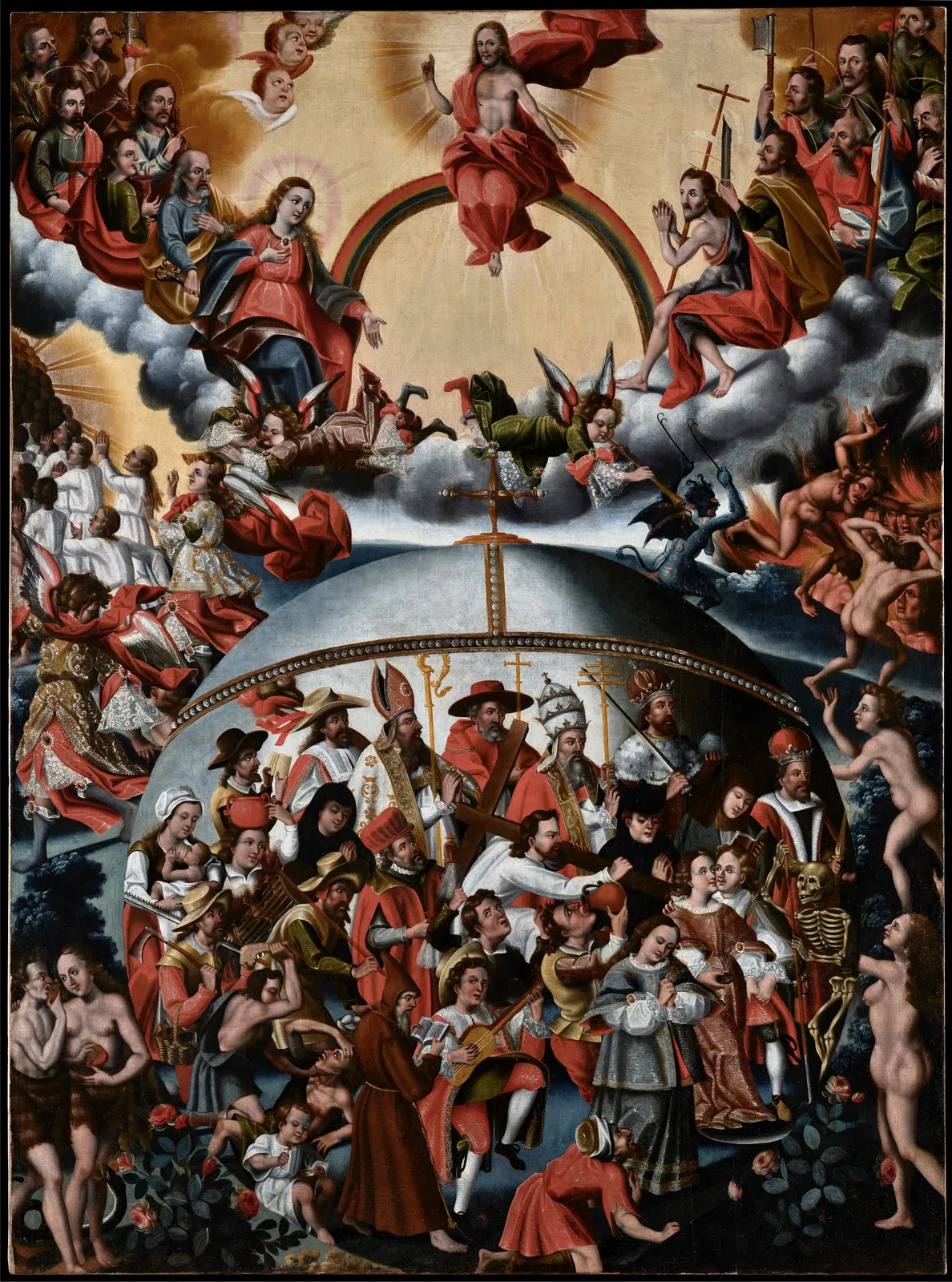
Leonardo Flores · The Last JudgementThe Macanese folding screen · Detail
Between Cultures
An image can cross an ocean and take on a new meaning when it arrives. A technique can travel from one workshop to another and be transformed by those who learn it. Many of the works that interest us bear traces of these journeys.
We are particularly drawn to artistic connections between Europe, the Americas and Asia: the movement of materials and models, and the ways in which artists made what they encountered their own. Enconchado paintings, folding screens and lacquerwork reveal how different traditions met and gave rise to new forms of expression.
These histories involved exchange, as well as conflict and unequal relationships. Understanding them means looking closely at the people who made the works, their knowledge and the circumstances in which they worked. This approach informs much of our research and our publications.
A personal perspective
Gonzalo Eguiguren
I grew up in a home where art was part of everyday life. My father, Jaime Eguiguren, and the works around us made this world familiar long before it became my profession. In my family, an interest in objects went hand in hand with travel, research and curiosity about other cultures.
I learned alongside my father and through direct contact with works of art. During my time at Jaime Eguiguren Art & Antiques, I located and studied the Pietà attributed to Melchor Pérez Holguín and was involved in its sale to the Los Angeles County Museum of Art, which acquired it in 2019.
Among the discoveries that have shaped my career are The Last Judgement by Leonardo Flores, which I personally researched, a Macanese folding screen from the late Ming dynasty and the Kotte fan known as the Pangolin Fan. Working with several collections of enconchado paintings has also been fundamental to my understanding of artistic connections between the Americas and Asia.
The rediscovery and study of Doña María Josefa Sánchez Morales, a Castilian painter of the Spanish Golden Age long overlooked by art history, has become another central focus of my work. I have brought together the largest known collection of works by the artist and her workshop, and led the project for her first exhibition and the first book devoted to her work.
Today, I continue this work through my gallery in Madrid. I am still moved by the moment when an object begins to reveal its history. Sharing that knowledge and working with the person who chooses to collect it are inseparable parts of what I do.
Gonzalo Eguiguren
Research and Publications
Research begins by recognising what we do not yet know about a work. A signature, a technique or a comparison with another object can open up a new interpretation, recover an attribution or place a work within a wider history.
This research combines close examination of the objects, the study of sources and dialogue with specialists. Its findings are shared through individual studies, catalogues and exhibitions, with attention to the evidence behind each proposal and the questions that remain open.
Enconchado paintings, the arts of the Manila Galleon and the paintings of María Josefa Sánchez are among these areas of enquiry. Publications and projects such as Discovering Viceregal Latin American Treasures, The Arts of the Manila Galleon and The Mantle of the People trace their development.
María Josefa Sánchez · Christ on the Cross and Saint John the Baptist
Rediscovery and research
Doña María Josefa Sánchez Morales
Led by Gonzalo Eguiguren, this project brings renewed attention to Doña María Josefa Sánchez Morales, a Castilian painter of the Spanish Golden Age whose work remained on the margins of art history. It grew from years of close study and the formation of the largest known collection of works by the artist and her workshop.
Her first exhibition and the first book devoted to her work brought together research by Gonzalo Eguiguren, Cathy Hall-van den Elsen and José María Quesada. The project assembled the first corpus of 24 identified works, bringing dispersed paintings into a shared framework for study. This research corpus extends beyond the works in the gallery’s collection.
A selection of works tracing Gonzalo Eguiguren’s career through discoveries, research and acquisitions. It brings together works in the gallery’s current collection and others now in museums or private collections, alongside projects undertaken with cultural institutions.
The Last Judgement by Leonardo Flores
Discovered and researched by Gonzalo Eguiguren, this painting holds a central place in his work on Andean painting. Its presentation traces the identification and study of a work that remains in the gallery’s current collection.
Known as the Pangolin Fan, this ivory, silver and carnelian fan was made in Kotte, in present-day Sri Lanka, between 1540 and 1551. Discovered by Gonzalo Eguiguren, it brings together his interests in ivory carving and artistic encounters between Asia and Europe.
Located and studied by Gonzalo Eguiguren during his time at Jaime Eguiguren Art & Antiques, the painting was acquired by LACMA in 2019. The museum dates it to around 1720 and catalogues it as attributed to Melchor Pérez Holguín.
Gonzalo Eguiguren’s work includes the study of the portrait of Fabio Chigi, Pope Alexander VII, in Discovering Viceregal Latin American Treasures and the sale of the portrait of Cardinal Giulio Rospigliosi to MUDEC in Milan, which acquired it in 2025. In his 2024 report, Davide Domenici identified these as the two known New Spanish portraits of this type.
The signed Saint Barbara by Bartolomé de Arenas is the starting point for Gonzalo Eguiguren’s research on the painter. His study proposes attributing to Arenas two portraits of Fray Payo Enríquez de Ribera, depicting him as Archbishop and as Viceroy of New Spain.
The loan of Saint Joseph and the Christ Child to the exhibition devoted to Luisa Roldán at the Museo Nacional de Escultura in Valladolid in 2024–2025 forms part of the gallery’s work to study European sculpture and share it with a wider public.
A collection can begin with a single work and a question. Knowledge grows through close attention, conversation and time.
We welcome both those making their first acquisition and those who have collected for many years. Explaining what we know about a work, what makes it distinctive and which questions remain open is part of building that relationship.
Living with a work of art allows us to return to it again and again, finding something we had not noticed before. That process of discovery can last a lifetime.